- Introduction
- The Shift from Google Search to AI Search
- How ChatGPT & Gemini Actually Choose Brands?
- Top factors influencing AI recommendations
- Ranking Factor #1: Authority Signals (Most Important)
- Ranking Factor #2: Mentions Across the Internet
- Ranking Factor #3: Structured Content (Very Important for LLMs)
- Ranking Factor #4: Third-Party Validation (Earned Media)
- Ranking Factor #5: Consistency of Brand Positioning
- Ranking Factor #6: Training Data + Live Search Data
- Ranking Factor #7: Big Brand Bias (Real Research)
- Ranking Factor #8: User Intent Matching
- Ranking Factor #9: Reviews & Community Signals
- Ranking Factor #10: AI Traffic Converts Better
- How to Make AI Recommend Your Brand?
- Conclusion
- FAQs
Introduction
AI search is changing how users discover brands online. Instead of browsing multiple websites, people now ask tools like ChatGPT, Gemini, Claude, or Perplexity to give direct answers.
“Best SEO agency”
“Best CRM software”
“Top marketing tools”
And AI gives only 3–5 brand recommendations.
Because of this shift, many businesses want to understand how Gemini and ChatGPT actually decide which brands to recommend. Unlike Google, these tools do not simply rank web pages. They analyze information from multiple sources, evaluate trust signals, and then generate an answer based on what looks most reliable. This process is part of what is now called AI SEO or Generative Engine Optimization, where the goal is to appear inside AI-generated responses instead of only search results.
Recent industry reports show how fast this change is happening. In 2023, <20% of internet users relied on AI search tools weekly. By 2025, that number crossed fifty percent, and projections for 2026 suggest that >70% of users will interact with AI-generated answers regularly. As usage grows, brands that appear in AI responses gain more trust and higher conversion rates than those that only rank in search engines.
| Year | Users using AI search weekly |
|---|---|
| 2023 | 18% |
| 2024 | 34% |
| 2025 | 57% |
| 2026 (est) | 72% |
So the big question is:
👉 How do Gemini & ChatGPT decide which brands to recommend?
The Shift from Google Search to AI Search
Traditional search → shows links
AI search → shows answers
Studies show:
✔ 93% of users interact with AI-generated answers weekly
✔ Brands appearing in AI answers get 2.3–4.8× more trust
✔ AI search visibility is becoming a ranking factor itself
How ChatGPT & Gemini Actually Choose Brands?
AI does NOT rank websites like Google.
Instead, LLMs:
- Read multiple sources
- Compare them
- Decide which brands look trustworthy
- Generate an answer
Research analyzing 50,000+ AI responses found clear patterns.
Top factors influencing AI recommendations
Ranking Factor #1: Authority Signals (Most Important)
Example weighting from AI citation research:
| Factor | Weight |
|---|---|
| Authority | 40% |
| Content Quality | 35% |
| Trust Signals | 25% |
Authority signals include:
👉🏻 Wikipedia page
👉🏻 News mentions
👉🏻 Backlinks
👉🏻 Reviews
👉🏻 Expert quotes
👉🏻 Industry sites
Why?
Because AI prefers sources it can trust.
Ranking Factor #2: Mentions Across the Internet
AI recommends brands that appear in many places. Examples of strong signals:
- Blogs
- Forums
- News
- Reviews
- Directories
- Comparison sites
Research shows brands with Wikipedia presence are mentioned much more often.
More mentions = more probability AI will pick you.
Ranking Factor #3: Structured Content (Very Important for LLMs)
LLMs prefer content that is easy to read. Good structure:
- Headings
- Lists
- FAQs
- Tables
- Comparisons
- Definitions
Why?
Because AI extracts answers, not pages.
Community SEO tests show structured pages get cited more often in AI responses.
Ranking Factor #4: Third-Party Validation (Earned Media)
AI trusts third-party sources more than your website. Research on Generative Engine Optimization shows AI prefers:
- News sites
- Review sites
- Forums
- Academic content
over brand websites.
This is why PR is becoming important again.
Ranking Factor #5: Consistency of Brand Positioning
AI looks for consistent identity. If your brand is called:
👉🏻 SEO agency
👉🏻 Digital agency
👉🏻 Marketing company
👉🏻 Growth partner
AI gets confused. Studies show brands with clear positioning appear more often in AI answers.
Example:
Bad → marketing / SEO / ads / dev / design
Good → SEO agency for SaaS
Consistency helps AI understand you.
Ranking Factor #6: Training Data + Live Search Data
Both ChatGPT & Gemini use:
- Training data
- Public internet data
- Web search (sometimes)
- Trusted datasets
Gemini uses filtered public data during training. ChatGPT may use:
- training knowledge
- search results
- trusted sources
This means:
👉 If your brand exists online → AI can use it
👉 If not → AI cannot recommend it
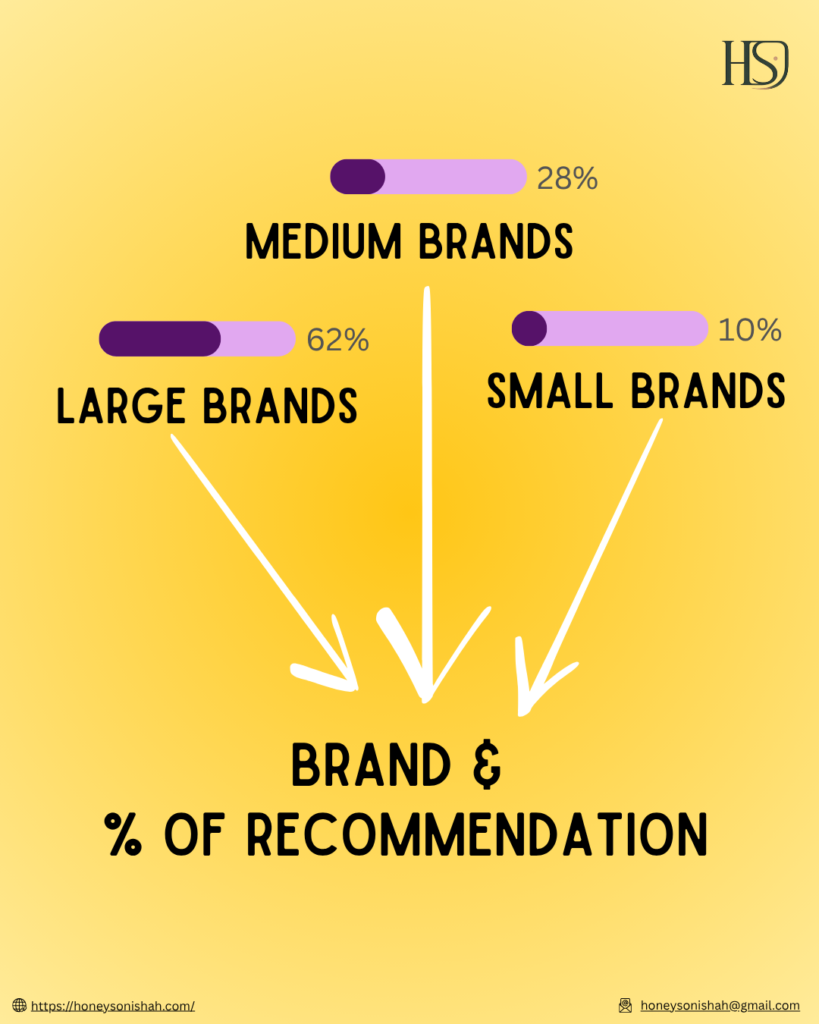
Ranking Factor #7: Big Brand Bias (Real Research)
Study of 184,000 queries found:
- Big brands appear more often
- High-authority domains dominate
- Small brands rarely appear
Another study showed:
When users ask discovery questions: Known brands appear 30× more often than new ones
Reason:
> More mentions
> More authority
> More trust signals
Small brands can rank, but need strong SEO + GEO.
Ranking Factor #8: User Intent Matching
AI tries to answer the exact question.
Example:
Query → best SEO agency for ecommerce
AI will pick brands that clearly say:
- SEO for ecommerce
- Ecommerce SEO agency
- Shopify SEO experts
- Not generic agencies.
Matching intent increases recommendation probability.
Ranking Factor #9: Reviews & Community Signals
AI reads: Reddit, Quora, G2, Trustpilot, Blogs, YouTube
Community discussions influence AI answers. Example from user testing:
| AI pulls info from reviews, comparisons, forums, and stats pages
This means: Real reputation matters more than SEO tricks.
Ranking Factor #10: AI Traffic Converts Better
| Source | Conversion |
|---|---|
| 1.7% | |
| ChatGPT | 15.9% |
| Claude | 17% |
| Gemini | ~ 3% |
How to Make AI Recommend Your Brand?
Do This:
✅ Build authority
✅ Get mentioned everywhere
✅ Create structured content
✅ Use comparisons & FAQs
✅ Get reviews
✅ Be consistent
✅ Get PR coverage
✅ Publish data & stats
✅ Build topical authority
Avoid This:
❌ Keyword stuffing
❌ Thin content
❌ No brand presence
❌ No mentions online
❌ No reviews
Future of SEO = AI SEO + GEO
New terms:
GEO → Generative Engine Optimization
AEO → Answer Engine Optimization
LLM SEO
AI Search Optimization
Traditional SEO alone is not enough anymore.
Conclusion
Gemini and ChatGPT choose which brands to recommend by analyzing authority, mentions, trust signals, content structure, and intent matching. The process is very different from traditional search ranking, which means businesses must adapt their strategy.
Instead of focusing only on keywords, brands now need strong online presence, consistent positioning, and reliable third-party validation. As AI search continues to grow, companies that understand these ranking factors will have a major advantage in visibility and conversions.
FAQs