Introduction
For the longest time, digital marketing had a clear rule:rank on Google, get traffic, convert leads.
Simple.
But that model has been quietly collapsing.
Today, users don’t just search, they ask.
And more importantly, they don’t browse the results anymore… they consume answers instantly.
Open Google and you’ll see AI Overviews.
Open ChatGPT or Perplexity and you’ll notice something even more important., there are no “10 blue links.” There’s just one synthesized answer.
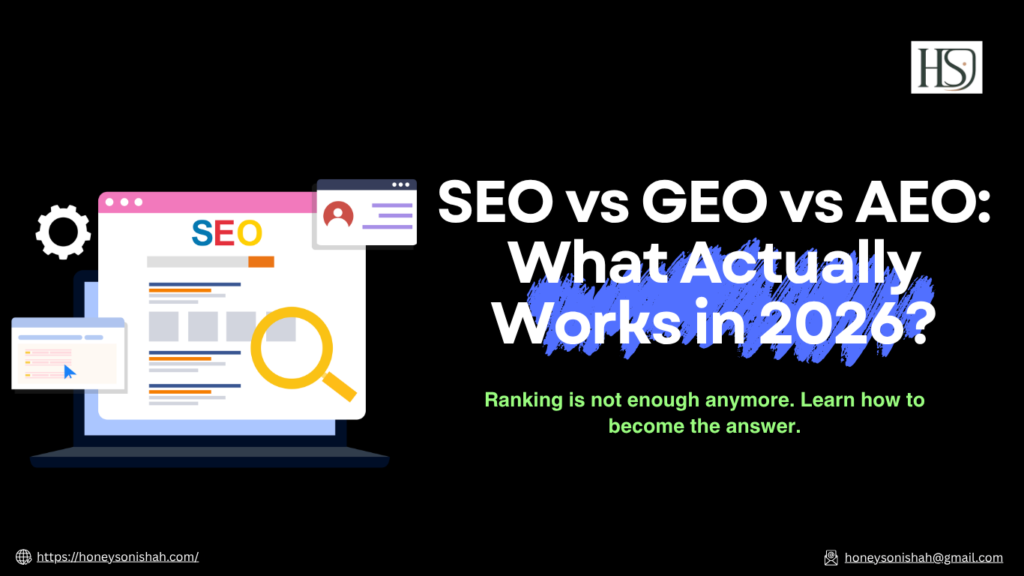
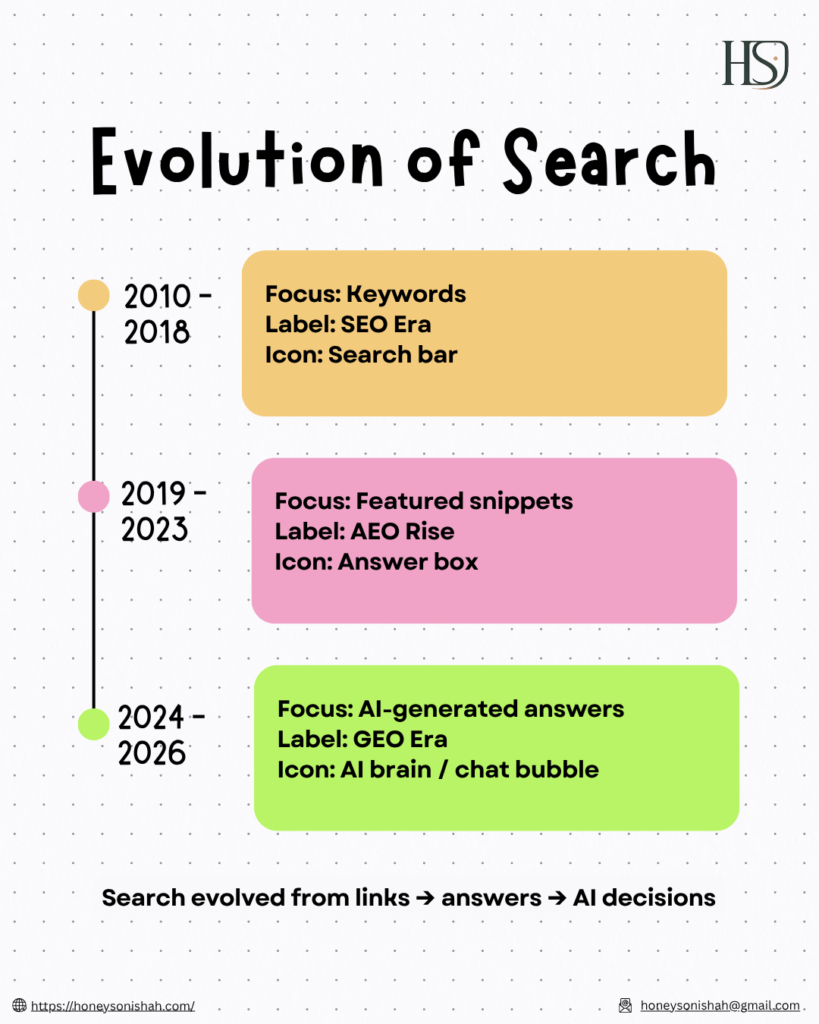
This shift has created three different approaches to visibility: SEO, AEO, and GEO. And if you’re still treating them as separate strategies, you’re already behind.
The Shift Nobody Can Ignore
Let’s ground this in reality.
More than half of all Google searches now end without a click. That means users find what they need directly on the search page. No website visit. No session. No analytics data.
At the same time, AI tools are becoming discovery engines. People are asking:
“Best marketing strategy for startups”
“How to generate leads for B2B”
“Top agencies in India”
And instead of showing links, AI gives final answers. This changes everything.
Because now the game is not just:
👉 “How do I rank?”
It’s:
👉 “How do I get included in the answer?”
SEO in 2026: Still the Foundation
Let’s clear one thing first – SEO is NOT dead. In fact, it’s still doing a lot of heavy lifting behind the scenes. Search engines and AI models still rely on:
- well-structured websites
- authoritative content
- backlinks and trust signals
If your site is technically weak or lacks authority, you won’t rank and you won’t be referenced either. But here’s where most people go wrong. They think SEO is the end goal. It’s not.
SEO helps you get discovered in traditional search. But in a world where answers are prioritized over links, discovery alone is not enough. You can rank #1 and still lose visibility if Google answers the query without needing your page.
AEO: The Battle for the Answer
Answer Engine Optimization (AEO) emerged as a response to this exact problem. Instead of optimizing for rankings, AEO focuses on clarity.
Think about how people search now:
They don’t type keywords like “SEO vs AEO difference.”
They ask:
👉 “What is the difference between SEO and AEO?”
Search engines recognize this shift. That’s why they now highlight:
- Featured snippets
- People Also Ask boxes
- AI-generated summaries
These elements don’t reward the longest article.
They reward the clearest answer.
That’s what AEO is about. It forces you to write like you’re answering a real human, not feeding an algorithm.
For example, a strong AEO response doesn’t say:
“SEO and AEO are distinct yet interconnected paradigms within digital ecosystems…”
It says:
“SEO helps you rank. AEO helps you become the answer users see instantly.”
Short. Clear. Direct.
That’s what gets picked.

GEO: The Real Game Changer
Now comes the layer most people still don’t fully understand – GEO.
Generative Engine Optimization is not about rankings or snippets. It’s about being mentioned inside AI-generated responses.
When someone asks ChatGPT:
👉 “Best performance marketing experts in India”
The AI doesn’t show websites. It composes an answer based on what it trusts. If your name, brand, or content exists across: blogs, case studies, interviews, third-party mentions; you increase your chances of being included.
That inclusion is powerful. Because the user doesn’t compare 10 options anymore. They trust the first complete answer they see.
This is a massive shift from traffic competition to trust competition.
A Real-World Example
Let’s make this practical.
Imagine someone searches:
👉 “How to generate B2B leads”
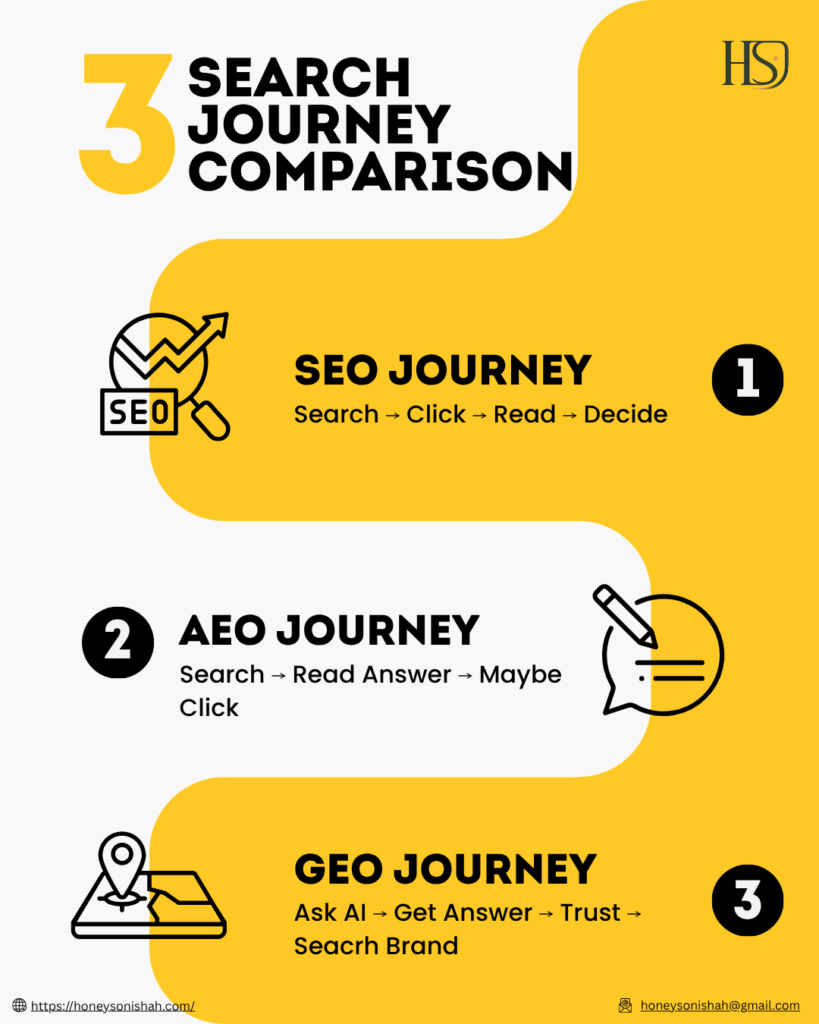
Old Journey (SEO-driven)
User clicks a blog → reads → explores → maybe converts
Current Journey (AEO-driven)
User reads a snippet → gets partial answer → may or may not click
New Journey (GEO-driven)
User asks AI → gets full strategy → trusts the source mentioned → directly searches that brand
Notice the difference? Traffic is no longer the first step. Trust is.
So, What Actually Works in 2026?
Here’s the honest answer most “experts” won’t give clearly: It’s not SEO vs AEO vs GEO. It’s how well you combine them.
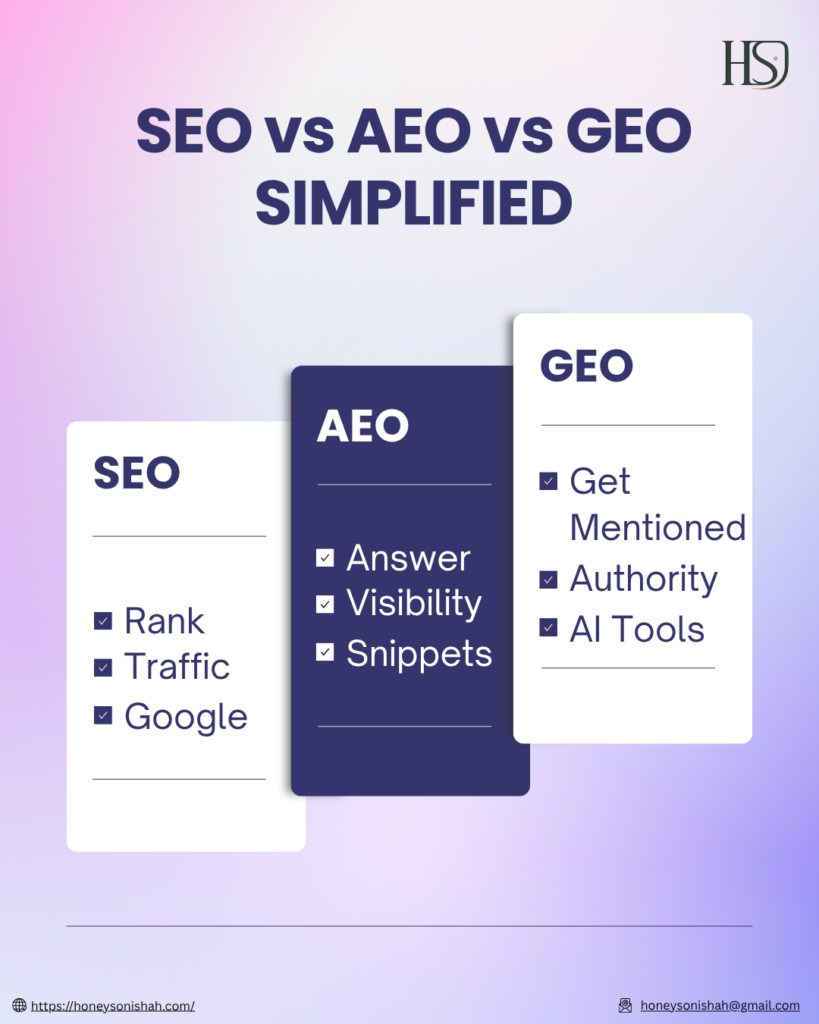
✔ SEO builds your base.
✔ AEO improves your visibility within search results.
✔ GEO determines whether you exist in AI conversations.
Ignore one, and the system breaks.
- Without SEO → you have no foundation
- Without AEO → you lose visibility in search features
- Without GEO → you disappear from AI-driven discovery
And right now, most businesses are missing the third piece entirely.
The Smarter Strategy Going Forward
If you’re serious about growth in 2026, your approach needs to evolve. Start with solid SEO, not just keywords, but structure, intent, and authority.
Then shift your writing style. Make your content answer-driven. Think in questions. Write like you’re solving, not explaining. Finally, expand beyond your website. Because GEO is not built only on your domain. It’s built on your presence across the internet.
That includes:
- case studies
- mentions on other sites
- consistent insights
- strong personal or brand positioning
In simple terms:
👉 SEO is your base
👉 AEO is your visibility
👉 GEO is your reputation
HSS Insight Corner 💡

“Ranking #1 doesn’t guarantee clicks anymore.”
“Write like you're answering a human, not an algorithm.”
“AI is the new homepage of the internet.”
The Biggest Mistake Right Now
Most businesses are still chasing rankings like it’s 2018. They celebrate:
- “We ranked #1”
- “We got traffic”
But they ignore:
- Are we being quoted by AI?
- Are we showing up in answers?
- Are we remembered?
That’s why traffic may grow, but influence doesn’t. And in 2026, influence is what drives conversions.
Conclusion
Search hasn’t disappeared. It has evolved. The winners today are not the ones who rank the highest. They are the ones who show up everywhere, especially where decisions are made instantly.
- SEO will get you seen.
- AEO will get you selected.
- GEO will make you trusted.
And if you get all three right, you don’t just compete, you dominate.
FAQs