Introduction
Lead generation has always been the starting point of business growth. Every company, whether a startup or a global enterprise, depends on a steady stream of potential customers entering its sales pipeline. For years, businesses relied on methods like cold calling, bulk email campaigns, form-based landing pages, and paid advertisements to generate leads. While these techniques helped companies reach large audiences, they often lacked precision.
Today, the marketing landscape is undergoing a significant transformation. Artificial intelligence is changing how businesses discover prospects, engage them, and convert them into customers. Instead of reaching thousands of people and hoping that a few respond, companies can now use AI to identify individuals who are already interested in their products or services.
This shift is redefining the future of lead generation, turning it from a numbers game into a system driven by data, intelligence, and predictive insights.
How AI is Transforming Lead Generation?
| Traditional Lead Generation | AI Lead Generation |
|---|---|
| Cold outreach | Intent-based targeting |
| Manual lead research | Predictive analytics |
| Mass email campaigns | Personalized messaging |
| Static forms | Conversational chatbots |
| Slow qualification | Instant lead scoring |
Why Lead Generation Is Evolving?
Modern consumers behave very differently compared to buyers a decade ago. Before speaking with a salesperson, most customers research extensively online. They read articles, compare products, watch reviews, and explore multiple options before making a decision.
Because of this behavior, traditional lead generation strategies have become less effective. Businesses can still generate thousands of leads through ads or forms, but many of these leads are not ready to buy. Sales teams often spend significant time contacting prospects who may never convert.
This is where AI-powered lead generation becomes valuable. Artificial intelligence can analyze large amounts of data such as browsing behavior, engagement patterns, search intent, and interaction history. Using these signals, AI helps businesses identify people who are most likely to become customers.
Research by Salesforce shows that companies using AI in sales and marketing report significantly improved lead quality and faster decision-making. Instead of chasing cold prospects, teams can focus on individuals who are already demonstrating buying intent.
From Mass Outreach to Intelligent Targeting
One of the biggest shifts in the AI era is the transition from mass outreach to intelligent targeting.
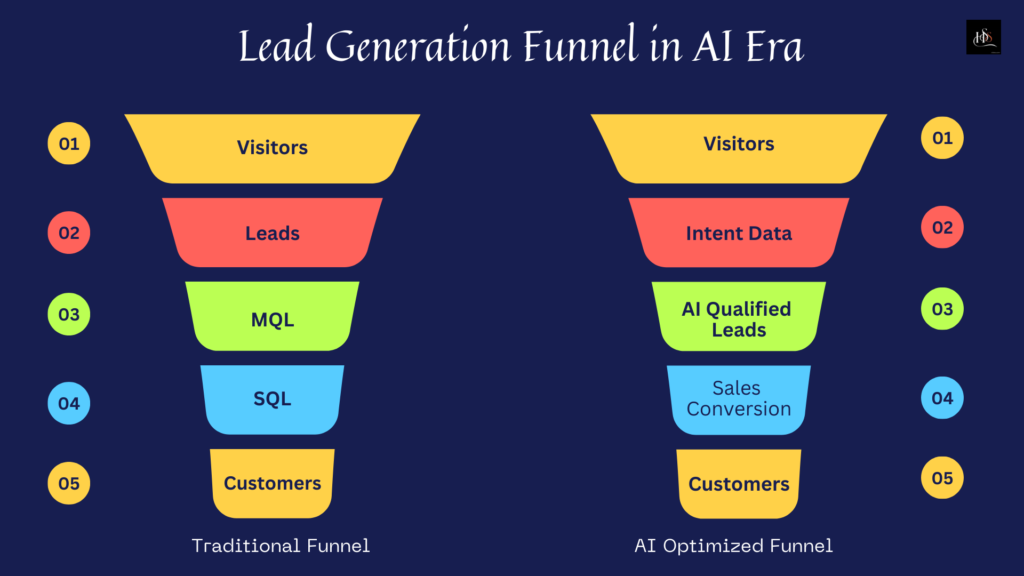
Traditional lead generation focused on reaching as many people as possible. Companies would run advertisements, send email campaigns, or publish content, hoping that a portion of the audience would respond. While this approach generated leads, it often created a large number of unqualified prospects.
AI changes this process by helping businesses identify high-intent prospects. By analyzing data points such as website visits, time spent on product pages, repeated searches, or engagement with specific content, AI systems can determine whether someone is actively researching a solution.
Instead of sending messages to thousands of random contacts, companies can focus on a smaller group of people who are already interested. This targeted approach not only improves conversion rates but also reduces marketing costs.
A report by McKinsey suggests that organizations using advanced analytics and AI in marketing can increase marketing ROI by up to 20–30 percent, largely because they focus their efforts on the most relevant prospects.
Personalization Will Become the Core of Lead Generation
Another major transformation happening in the AI era is the rise of deep personalization.
Modern customers expect brands to understand their needs. Generic messages such as “Hello valued customer” or broad promotional emails rarely capture attention anymore. Buyers want communication that feels relevant to their situation.
Artificial intelligence enables this level of personalization at scale. AI systems can analyze information such as industry, job role, company size, browsing history, and past interactions to tailor communication for each prospect.
For example, two visitors may land on the same website but see different messaging. A startup founder might see information about affordable growth tools, while a large enterprise executive might see content related to scalability and integration. This kind of personalized experience significantly increases engagement.
Studies show that personalized marketing campaigns can generate significantly higher engagement rates compared to generic campaigns, because customers feel that the brand understands their needs.
Conversational Lead Generation Is Replacing Static Forms
For years, most websites used simple contact forms to capture leads. Visitors would fill out their name, email, and phone number, then wait for someone from the company to contact them. The problem with this approach is that it interrupts the user’s experience and often delays the response.
AI-powered chat systems are changing this process. Instead of filling out a form and waiting, visitors can interact with a conversational assistant that answers questions instantly. These AI chat assistants can guide users through product information, recommend services, and even schedule meetings with sales teams.
This conversational approach feels more natural and engaging for users. It also allows companies to qualify leads in real time. For example, an AI assistant can ask about a visitor’s business size, budget, or specific requirements, helping the sales team understand whether the prospect is a good fit.
According to research by Drift, companies that respond to leads within the first few minutes significantly increase their chances of conversion. AI chat assistants make this immediate response possible, even outside business hours.

Predictive Lead Scoring Is Making Sales More Efficient
One of the most powerful applications of AI in lead generation is predictive lead scoring. Traditionally, companies ranked leads based on simple factors like job title or email engagement. While this approach helped prioritize prospects, it often failed to capture deeper behavioral signals.
Predictive lead scoring uses machine learning to evaluate a wide range of data points, including how prospects interact with content, how frequently they return to the website, which pages they visit, and what topics they search for.
By analyzing these signals, AI assigns a probability score indicating how likely a lead is to convert into a customer. Sales teams can then prioritize their efforts on leads with the highest scores.
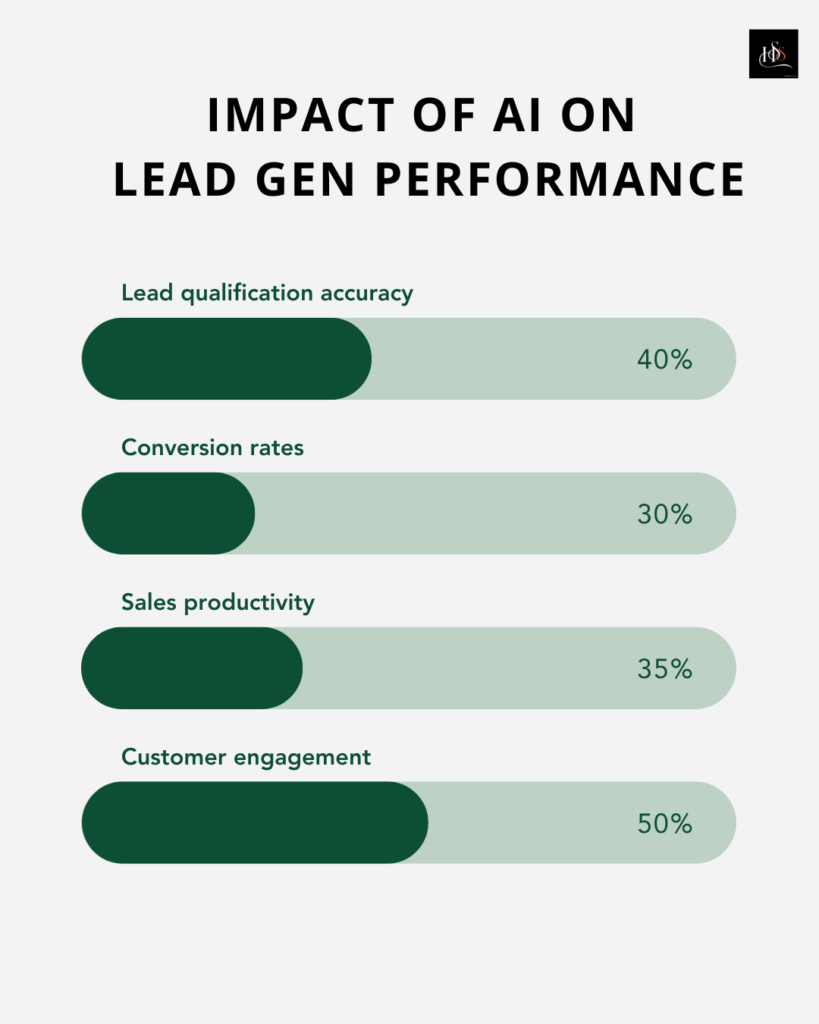
Companies that implement predictive lead scoring often report improved sales efficiency because their teams spend less time pursuing unqualified prospects and more time engaging with serious buyers.
Content Will Continue to Drive Lead Generation
Despite rapid technological advancements, content marketing remains one of the most powerful drivers of lead generation.
When potential customers search for information online, they usually begin with educational content. They read blogs, watch videos, explore case studies, and compare solutions before making decisions. Businesses that consistently publish valuable content naturally attract these prospects.
Artificial intelligence enhances content marketing by helping marketers understand what topics audiences are searching for and what type of content performs best. AI tools can analyze search trends, user engagement, and competitor content to identify opportunities for growth.
As a result, businesses can create content that directly addresses the questions and challenges their target audience faces. Instead of producing random articles, they can develop strategic content that attracts qualified leads.
Research from the Content Marketing Institute shows that companies investing consistently in content marketing generate significantly more inbound leads compared to those relying only on paid advertising.
The Rise of Autonomous AI Sales Agents
One of the most fascinating developments shaping the future of lead generation is the emergence of autonomous AI agents.
These systems can perform many tasks traditionally handled by sales development representatives. They can research potential prospects, analyze company data, generate personalized outreach messages, follow up with leads, and schedule meetings automatically.
Instead of manually searching for prospects, businesses can deploy AI agents that continuously scan the market for potential customers. These agents analyze signals such as hiring trends, technology adoption, funding announcements, or industry news to identify companies that might need a particular solution.
While human sales teams will always play a critical role in relationship building and negotiation, AI agents can handle repetitive tasks and allow sales professionals to focus on high-value interactions.

What Businesses Should Do to Prepare?
As lead generation continues to evolve, businesses need to adapt their strategies to stay competitive. The organizations that succeed will be the ones that combine human expertise with intelligent automation.
Investing in data quality is a crucial first step. AI systems rely on accurate data to generate insights, so companies must ensure that their CRM systems and marketing databases are well maintained.
Businesses should also explore marketing automation platforms that integrate AI capabilities. These tools can help automate outreach campaigns, personalize messaging, and analyze lead behavior.
Equally important is maintaining a strong content strategy. High-quality content attracts prospects, builds trust, and positions a brand as an authority in its industry.
Conclusion
The future of lead generation is being shaped by artificial intelligence, data intelligence, and personalized customer experiences. Instead of relying on large volumes of generic leads, businesses are moving toward smarter strategies that prioritize quality, relevance, and timing.
AI is not replacing marketing and sales professionals; rather, it is empowering them with deeper insights and automation tools that make their work more effective.
Companies that embrace AI-powered lead generation will be able to identify opportunities faster, engage prospects more effectively, and convert leads into customers with greater efficiency.
As technology continues to evolve, the businesses that combine strategic thinking with AI-driven tools will lead the next generation of customer acquisition.
FAQs