- Introduction
- The Real Story Behind India’s Digital Growth
- Tier 2 & Tier 3 India: Not “Emerging” Anymore
- Metro vs Tier 2/3 Comparison Chart
- Mobile-First Is Now Behavioral, Not Strategic
- The Shift Toward Vernacular and Cultural Context
- Short Video Is the New Discovery Engine
- Hyperlocal Marketing Is Becoming a Competitive Advantage
- Voice Search and Conversational Behavior
- The Role of AI and Automation
- Digital Payments Are Fueling Faster Conversions
- E-commerce Growth Beyond Metros
- Challenges You Can’t Ignore
- What the Future Looks Like?
- Conclusion
- FAQs
Introduction
For the longest time, digital marketing in India was built around metros. Campaigns were designed for urban audiences, English-speaking users, and high-ticket buyers concentrated in a handful of cities. That model worked, until it didn’t.
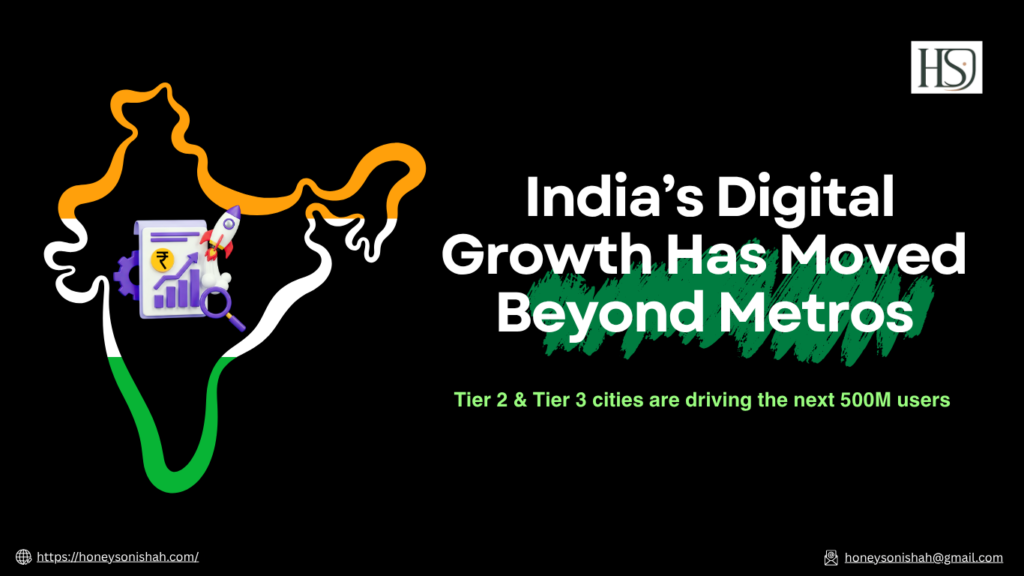
By 2026, the center of gravity has clearly shifted. The next phase of growth is not coming from Mumbai, Delhi, or Bangalore. It is coming from cities like Indore, Surat, Lucknow, Rajkot, Coimbatore, and thousands of smaller towns that were once considered “emerging markets.”
These users are no longer new to the internet. They are experienced, confident, and, most importantly, ready to spend. If anything, they are reshaping how digital marketing actually works in India.
The Real Story Behind India’s Digital Growth
India today has crossed the milestone of 1 billion internet users, and what’s more interesting is where this growth is coming from. A significant majority of new users over the past few years have come from non-metro regions. In fact, more than half of India’s internet population now resides in Tier 2 and Tier 3 cities and rural areas.
Mobile is the backbone of this transformation. With over 85% of users accessing the internet through smartphones, the way people discover, consume, and purchase has fundamentally changed. Data consumption has also exploded, with average monthly usage per user crossing 15–20 GB, largely driven by video.
This is not just access, it’s deep engagement. And that changes everything for marketers.
The Real Story Behind India’s Digital Growth
Tier 2 & Tier 3 India: Not “Emerging” Anymore
There is still a tendency among brands to treat smaller cities as “developing markets.” That assumption is outdated.
Consider this: during major shopping periods like festive sales, Tier 2 and Tier 3 cities are contributing a disproportionately high share of transactions. In some cases, they drive 2–3x growth compared to metro markets, especially in categories like fashion, electronics, and jewelry. Even prepaid transactions, which indicate higher trust, have seen strong adoption in these regions.
What this tells you is simple: the user mindset has evolved. These are not hesitant buyers anymore. They compare, evaluate, and purchase with confidence. The only difference is that their triggers, preferences, and trust signals are different from metro users.
Metro vs Tier 2/3 Comparison Chart
| Factor | Metro | Tiwe 2/3 |
|---|---|---|
| Language | English-heavy | Vernacular |
| Trust | Brand-driven | Community-driven |
| CPC | High | Lower |
| Conversion | Moderate | Often higher |
| Discovery | Search | Social/video |
Mobile-First Is Now Behavioral, Not Strategic
In Tier 2 and Tier 3 markets, mobile is not just the primary device, it is often the only device. This creates a very different kind of user journey.
People are not browsing websites the way desktop users used to. They are scrolling, tapping, watching, and interacting in quick bursts. Attention spans are shaped by short-form video, and expectations are shaped by fast-loading, app-like experiences.
If your website takes time to load, if your landing page is cluttered, or if your checkout process is not frictionless, you don’t lose conversions gradually, you lose them instantly.
This is why mobile-first design is no longer a best practice. It is survival.
The Shift Toward Vernacular and Cultural Context
One of the biggest shifts in digital marketing in India is the rise of vernacular content. English is no longer the default language of the internet, especially outside metros.
Users prefer consuming content in Hindi, Gujarati, Marathi, Tamil, or whichever language they are most comfortable with. But this is not just about translation. It is about context.
A message written in perfect English but disconnected from local culture will underperform compared to a slightly imperfect regional message that feels relatable. The tone, references, humor, and even visual cues need to align with the audience’s environment.
Brands that understand this are seeing significantly higher engagement and conversion rates. Those that don’t often feel “distant,” even if their product is relevant.
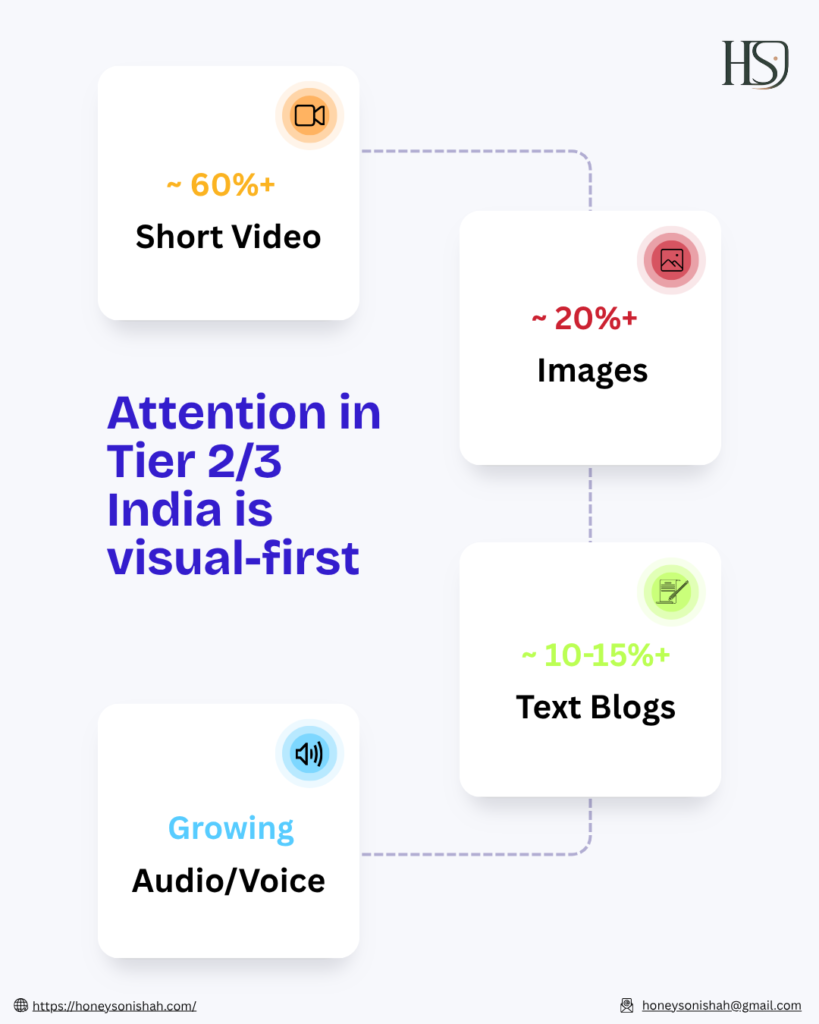
Short Video Is the New Discovery Engine
Search is no longer the starting point for many users. Discovery now happens through scrolling, especially via short video platforms.
A large chunk of short-form video consumption in India comes from non-metro audiences. These users are spending hours on platforms like Instagram Reels and YouTube Shorts, not just for entertainment but also for product discovery.
This has fundamentally changed the funnel. Instead of searching for a product, users often discover it through a video, build trust through repeated exposure, and then make a purchase, sometimes without ever visiting a traditional website.
This is why creator-led content and influencer marketing are becoming central, especially in Tier 2 and Tier 3 markets.
Hyperlocal Marketing Is Becoming a Competitive Advantage
Another major shift is the importance of hyperlocal targeting. In smaller cities, trust is often built at a local level.
People are more likely to engage with businesses that feel close to them, geographically and culturally. Searches with “near me” intent have increased significantly, and local SEO has become a powerful lever.
A business that ranks well in a specific locality, has strong Google reviews, and maintains an active presence in that region often outperforms larger, more generic competitors.
In many cases, the battle is no longer national, it is neighborhood-level.
Voice Search and Conversational Behavior
Voice search adoption has been growing steadily in India, and it is particularly prominent in Tier 2 and Tier 3 regions. Users are more comfortable speaking than typing, especially in regional languages.
This leads to more conversational queries. Instead of typing “best coaching institute Ahmedabad,” a user might say something like, “Ahmedabad ma best coaching kya che?”
This changes how content needs to be structured. Traditional keyword stuffing doesn’t work here. Content needs to answer real questions in a natural, conversational way. FAQ sections, long-tail keywords, and voice-friendly phrasing become critical.
The Role of AI and Automation
AI has quietly become a core part of digital marketing operations, even for smaller businesses. From chatbots handling initial queries on WhatsApp to automated follow-ups and personalized ad targeting, AI is improving efficiency and scalability.
In Tier 2 and Tier 3 markets, where response time and trust-building are crucial, automation plays a key role. A quick reply, a relevant message, or a timely follow-up can significantly increase conversion chances.
This is not about replacing human interaction, it’s about enabling it at scale.

Digital Payments Are Fueling Faster Conversions
The widespread adoption of UPI has removed one of the biggest barriers to online transactions, payment friction.
With hundreds of millions of daily transactions happening through digital payment systems, users are now comfortable making instant purchases. This has led to a rise in impulse buying, especially when combined with social media discovery.
For marketers, this means shorter funnels. The gap between interest and purchase is shrinking.
E-commerce Growth Beyond Metros
E-commerce is no longer an urban phenomenon. A significant portion of new online shoppers is coming from smaller cities.
These users are highly responsive to offers, influencer recommendations, and social proof. Platforms that simplify selling, especially through social and messaging apps, are seeing strong traction.
In many ways, Tier 2 and Tier 3 markets are not just adopting e-commerce, they are redefining how it works.
Challenges You Can’t Ignore
- While the opportunity is massive, there are still challenges. Digital literacy varies, trust needs to be built more carefully, and language diversity adds complexity to communication.
- Infrastructure gaps still exist in certain areas, and not all users are equally comfortable with advanced digital experiences.
- However, brands that take the time to educate, simplify, and build trust often find these challenges turning into competitive advantages.
What the Future Looks Like?
Looking ahead, the direction is clear. Regional content will continue to dominate, AI-driven personalization will become more sophisticated, and hyperlocal strategies will become standard practice.
The next wave of internet users and customers will not come from metros. They will come from Bharat.
And the brands that win will be the ones that understand this shift early and adapt accordingly.
Conclusion
Digital marketing in India is no longer about scaling what worked in metros. It is about rethinking strategies for a completely different audience, one that is diverse, fast-growing, and increasingly influential.
Tier 2 and Tier 3 cities are not just an opportunity. They are the present and the future of digital growth in India.
If your strategy is still metro-centric, you’re not just missing out, you’re falling behind.
FAQs