- Introduction
- Why Structure Is the New SEO Advantage?
- The Role of TL;DR: Your First Impression for AI
- Why FAQs Are the Most Powerful Structure Today?
- Real Insight: Why FAQs Work
- Schema Markup: The Hidden Layer Most Ignore
- A Simple Before vs After Scenario
- The Shift: From Writing Content to Designing Answers
- Where Most Content Fails?
- Final Thought
- FAQs
Introduction
Search has quietly shifted from ranking pages to extracting answers.
When someone asks a question today, platforms like ChatGPT or Google’s AI results don’t send users through ten blue links anymore. They generate a direct response, often pulling pieces from multiple sources and stitching them into one clean answer.
That means your content is no longer competing to be clicked. It’s competing to be selected.
And selection doesn’t happen because your article is long or keyword-heavy. It happens because your content is structured in a way machines can understand, trust, and reuse.
Why Structure Is the New SEO Advantage?
Think of AI like a very fast reader with a very specific goal:
“Find the clearest, most reliable answer in the least amount of time.”
It scans content looking for patterns:
- Where is the direct answer?
- Is this section self-contained?
- Can I quote this without rewriting it?
If your content is buried in long paragraphs, vague introductions, or scattered ideas, AI simply skips it. But when your content is structured, with summaries, question-based sections, and clear signals, it becomes easy to extract.
That’s the entire game.
The Role of TL;DR: Your First Impression for AI
A TL;DR section is not just for lazy readers anymore. It’s for machines.
When AI systems process a page, they often prioritize the top portion of the content. If that section clearly answers the main query, your chances of being used in generated responses increase significantly.
A strong TL;DR doesn’t try to be clever. It tries to be clear.
For example:
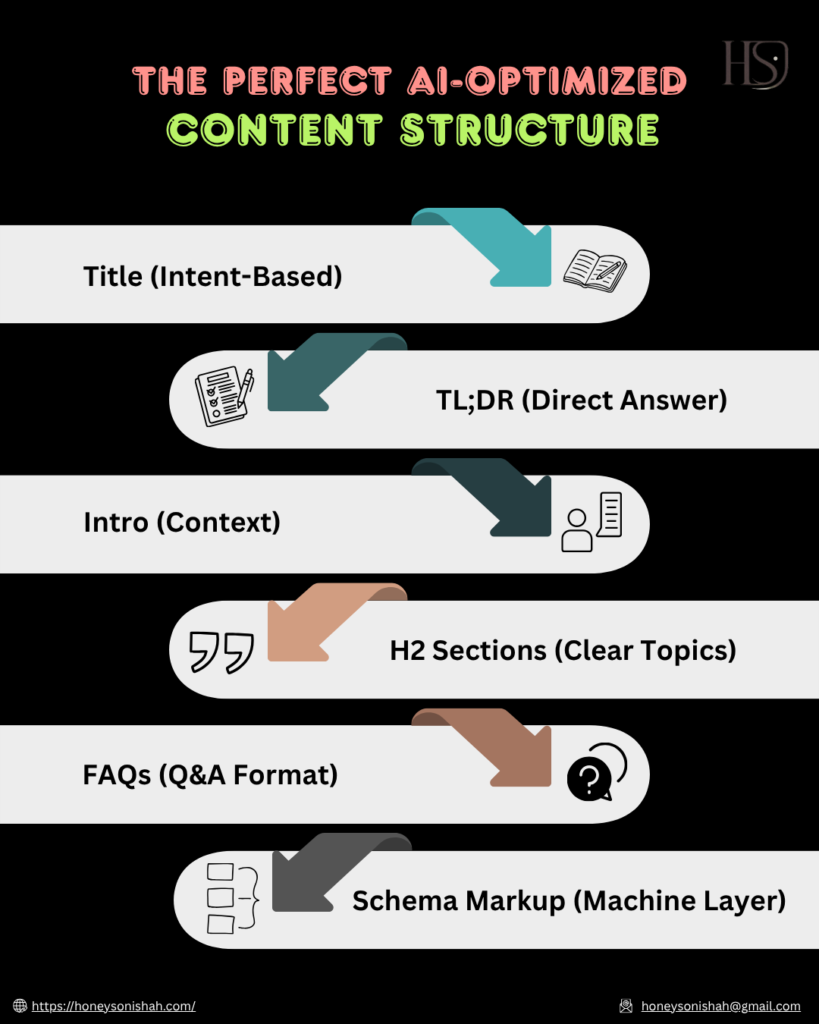
To structure content for AI, start with a direct summary (TL;DR), use question-based sections like FAQs, and implement schema markup so machines can easily interpret and extract your content.
This works because it:
- Answers the query immediately
- Uses natural language similar to user prompts
- Stands alone as a complete idea
In many cases, this exact block can be lifted and used as an AI-generated answer.
Why FAQs Are the Most Powerful Structure Today?
If there’s one format that aligns perfectly with how AI works, it’s the question-and-answer format.
- AI systems are trained on conversations.
- Users search in questions.
- And responses are generated as answers.
So when your content already follows that structure, it becomes extremely easy to reuse. But here’s where most people go wrong, they treat FAQs as an afterthought.
They add generic questions like:
- “What is SEO?”
- “Why is SEO important?”
That doesn’t work anymore. Modern FAQs need to reflect real, intent-driven queries. For example:
- “How do you structure content for AI answers?”
- “Does FAQ schema still matter for AI search visibility?”
- “Where should TL;DR be placed in a blog?”
Each answer should feel complete on its own. Not too long, not too short, just enough to be useful and extractable.
Real Insight: Why FAQs Work
In multiple content experiments and SEO studies:
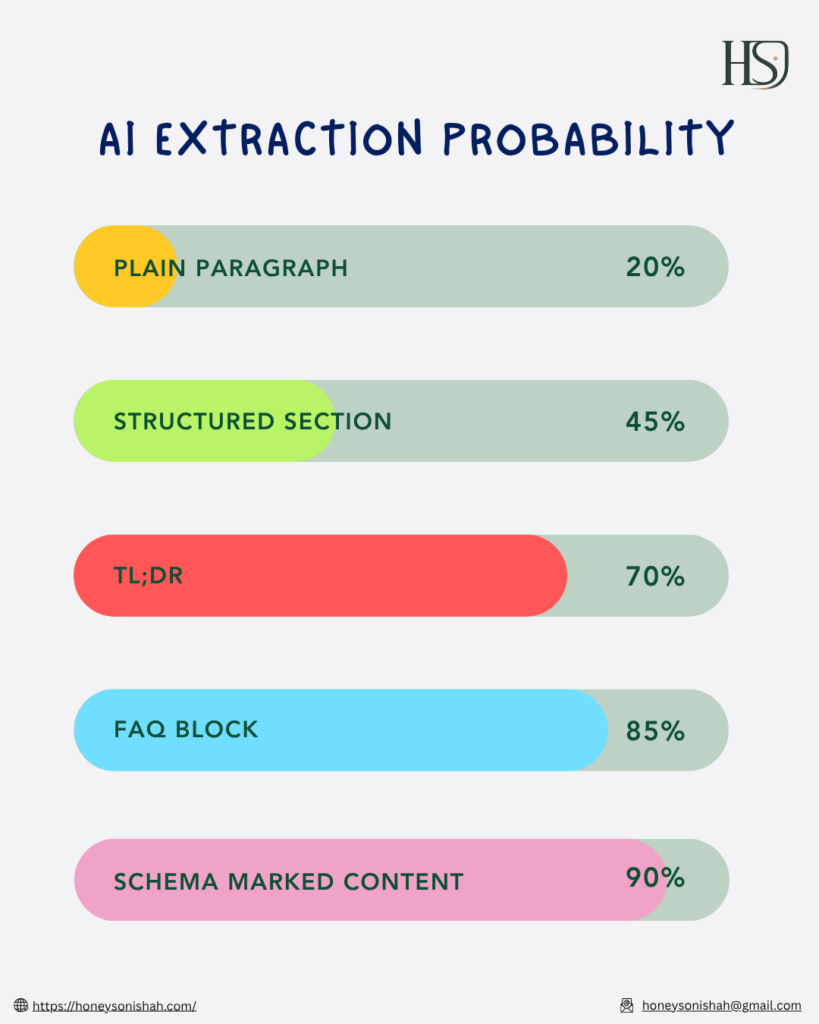
- Pages with well-structured FAQ sections saw up to 60–70% higher visibility in AI-generated results
- Content with clear Q&A blocks was significantly more likely to be cited in tools like ChatGPT and Perplexity
- Even after Google reduced FAQ rich results in SERPs, their importance for AI extraction actually increased
This shift is important to understand: FAQs are no longer for Google snippets. They’re for AI comprehension.
Schema Markup: The Hidden Layer Most Ignore
Everything we’ve talked about so far is visible to users. Schema is different. It’s a layer of meaning added behind the scenes. When you use schema markup, you’re essentially telling machines:
- “This is a question”
- “This is an answer”
- “This is an article”
- “This is a step-by-step guide”
Without schema, AI has to guess. With schema, it knows.
For example, adding FAQ schema explicitly labels your content as a structured Q&A dataset. That increases the likelihood that AI systems will treat it as a reliable source of answers.
What’s surprising is how underused this still is.
A large percentage of websites either don’t use schema at all or implement it incorrectly which creates a massive opportunity.
A Simple Before vs After Scenario
Let’s say you publish two blogs on the same topic.
Blog A:
- Long introduction
- No summary
- No clear structure
- No FAQs
- No schema
Blog B:
- Starts with a TL;DR
- Uses clear H2/H3 sections
- Includes 8–10 targeted FAQs
- Implements FAQ schema
- Uses short, direct answer blocks
Even if both blogs have similar content quality, Blog B is far more likely to be: picked by AI, summarized, cited in responses
Because it’s not just informative, it’s extractable.
The Shift: From Writing Content to Designing Answers
This is the mindset shift most people haven’t made yet.
Earlier, content was written to:
Explain things in depth
Now, content must be designed to:
Deliver answers instantly
That doesn’t mean reducing quality. It means improving clarity and accessibility. Every section of your blog should be able to stand independently. Every answer should feel complete even if taken out of context.
Because that’s exactly what AI does.

Where Most Content Fails?
The biggest mistake is assuming that good writing is enough. It’s not.
You can write a brilliant article, but if:
- the answer is buried
- the structure is unclear
- the format is not extractable
AI will ignore it. Another common issue is over-optimization, stuffing keywords without improving structure. That worked in traditional SEO. It doesn’t work here.
Clarity beats cleverness. Structure beats length
Final Thought
If you remember just one thing, let it be this:
AI doesn’t reward the best-written content.
It rewards the best-structured answers.
So the goal is simple:
- Make your content easy to scan
- Easy to understand
- Easy to extract
Do that consistently, and you won’t just rank. You’ll be the answer.
FAQs