Introduction
Search engines are no longer the only way people find information.
Today, millions of users ask questions directly to AI tools like ChatGPT, Gemini, Perplexity, and Copilot instead of typing queries into Google. Instead of showing ten blue links, these tools generate a single answer using multiple sources.
This change is forcing a new type of SEO.
Ranking on Google is no longer enough.
Now you also need to rank inside AI answers.
This new field is called AI Search Optimization or Generative Engine Optimization (GEO), and it requires a different strategy than traditional SEO.
In this guide, we will go deep into how AI search works, what ranking factors matter, and how you can optimize your content so AI tools actually use it as a source.
The Growth of AI Search
AI search usage has grown extremely fast in the last two years.
Industry reports show that AI-based search tools are gaining users much faster than traditional search engines did in their early years.
| Year | AI Search Users (Millions) |
|---|---|
| 2023 | 120 |
| 2024 | 310 |
| 2025 | 720 |
| 2026 | 1100+ |
This kind of growth explains why many websites are seeing traffic shifts even without ranking changes on Google.
Another important trend is zero-click search.
Studies show that a large percentage of queries are answered directly without users opening any website. When AI gives the answer, only the sources used by the model get visibility.
This means the real goal of modern SEO is not just ranking, it is being selected as a source.
How AI Search Ranking Works?
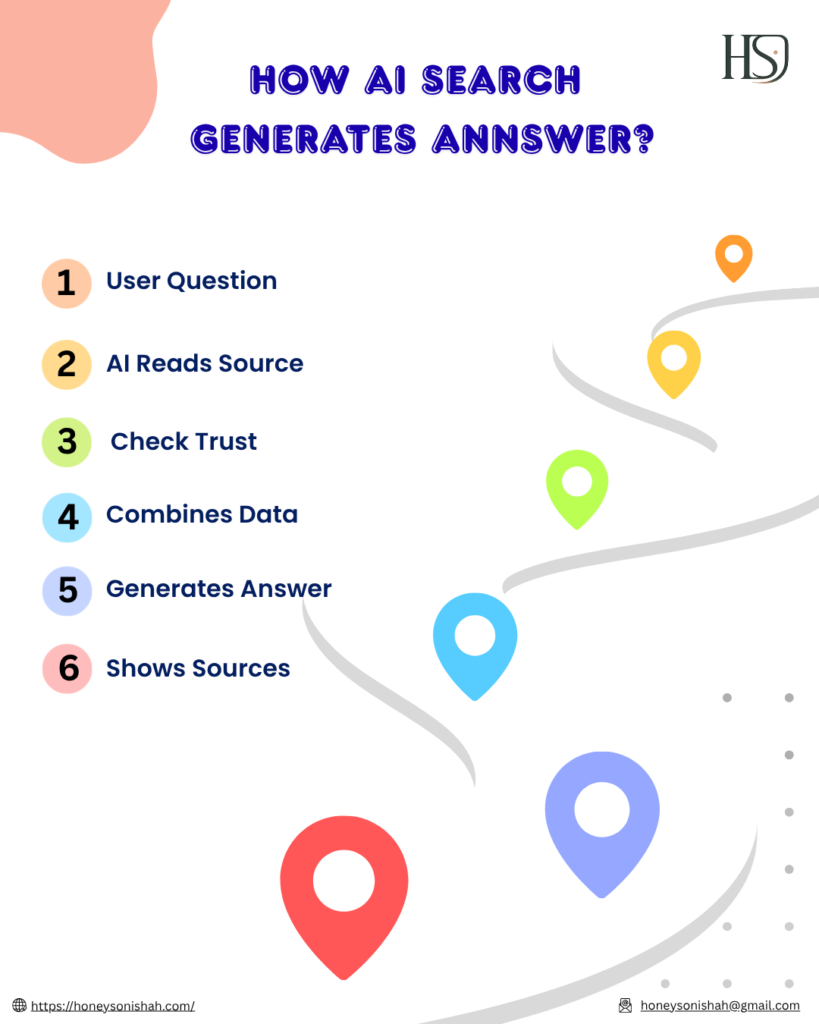
Traditional search engines rank pages. AI search engines generate answers. To generate an answer, AI systems:
- Understand the question
- Retrieve relevant content
- Evaluate trust
- Combine information
- Generate final response
Because of this process, ranking factors are different. mportant signals for AI search include:
- Clarity of Explanation
- Topical Authority
- Factual Accuracy
- Structured Content
- Trusted Sources
- Entity Recognition
- Freshness of Information
Backlinks still matter, but they are no longer the only signal. Content quality matters more than ever.
What is Generative Engine Optimization (GEO)
Generative Engine Optimization means optimizing content so that AI systems use it when generating answers.
Unlike traditional SEO, GEO focuses on making content easy for language models to understand.
Good GEO content usually has:
- Clear Headings
- Question-based Sections
- Real Data
- Definitions
- Examples
- FAQs
- Topic Depth
Websites that follow these patterns appear more often in AI answers. This is why research sites, documentation pages, and long guides are frequently used by AI.
Why Some Pages Appear in ChatGPT Answers?
Let’s look at a simplified example of how AI might choose sources. Suppose multiple sites write about AI SEO.
| Site | Backlinks | Content Depth | Structure | AI Visibility |
|---|---|---|---|---|
| Site A | High | Low | Poor | Low |
| Site B | Medium | High | Good | High |
| Site C | Low | High | Excellent | High |
Even with fewer backlinks, Site B and C may appear more often because their content is easier for AI to use.
This shows that authority + structure + clarity can outperform backlinks alone in AI search.

Key Factors to Rank in ChatGPT & AI Search
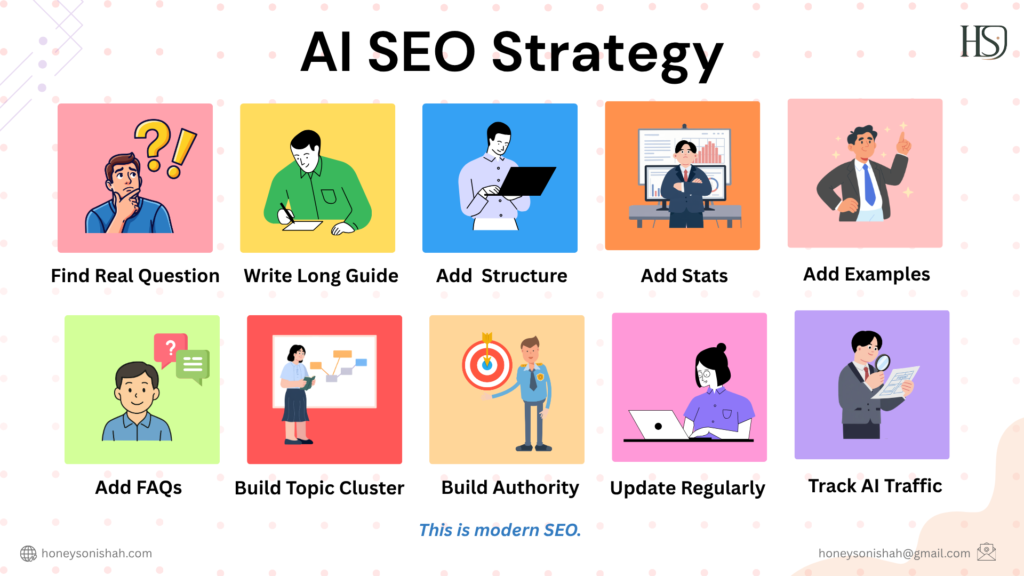
1. Write Question-Focused Content
AI answers questions, so your content should do the same.
Good headings:
✅ What is AI SEO?
✅ How to rank in ChatGPT?
✅ How does AI search work?
✅ What is GEO?
Bad headings:
❌ Best SEO tricks
❌ Ultimate marketing tips
Question-based content matches user intent better and increases AI visibility.
2. Build Topical Authority with Multiple Articles
AI prefers sources that show expertise across a topic. Instead of one post, build a cluster. Example cluster for AI SEO:
- AI SEO guide
- GEO guide
- ChatGPT ranking factors
- AI vs Google SEO
- AI content optimization
- LLM SEO
- AI search case study
When your site covers the topic deeply, AI trusts it more. Authority is one of the strongest ranking factors.
3. Use Structured Formatting
AI models extract information easier from structured content.
Use: Headings, Bullet Points, Tables, FAQs, Short Paragraphs, Definitions
Example structure:
- Heading
- Short answer
- Explanation
- Example
- Data
This format increases the chance of being quoted.
4. Add Real Data & Statistics (But Naturally)
AI prefers factual content.
Example:
❌ Bad
AI search is growing fast.
✅ Better
AI search users crossed 1 billion in 2026 according to industry analytics reports.
Numbers increase trust. But do not add stats everywhere only where useful.
5. Build Authority Outside Your Website
AI reads many sources, not just your site. It may use:
- Blogs
- Forums
- Research Papers
- Reviews
- Social Posts
More mentions = more trust.
Ways to increase authority:
- Guest Posts
- Interviews
- Forum Discussions
- Citations
- Backlinks
- Brand mentions
Reputation matters in AI search.
6. Optimize for Entities, Not Just Keywords
AI understands concepts, not just words. Use real terms naturally:
- ChatGPT
- Gemini
- Perplexity
- Google Search
- AI SEO
- LLM
- Generative AI
This helps AI understand context. Context improves ranking.
7. Use FAQs Sections for AI Visibility
FAQ sections are very powerful for AI search. They work because:
- Questions match user queries
- Answers are short
- Structure is clear
Many AI answers come from FAQ sections. Always add FAQs at the end of guides.
8. Keep Content Updated
AI prefers recent information. Update content when:
- New tools appear
- Ranking factors change
- Stats change
- Algorithms change
Fresh content often gets selected more often.
Future of SEO: Google + AI Together
Google is still dominant. But AI search is growing fast. Future SEO will require:
- Traditional SEO
- AI SEO
- Content Authority
- Structured Writing
- Brand Trust
Websites that adapt early will get the most traffic. Those who ignore AI search may lose visibility slowly without understanding why.
Conclusion
Search is no longer limited to Google. With the rapid growth of AI tools like ChatGPT, Gemini, and Perplexity, ranking inside AI-generated answers is becoming just as important as ranking on traditional search engines. This shift means SEO is evolving from keyword-focused optimization to authority-driven, structured, and trustworthy content that AI systems can understand and use.
To rank in AI search, websites need more than backlinks and keywords. Content must clearly answer questions, cover topics in depth, include real data, and build strong topical authority. This approach, known as Generative Engine Optimization (GEO), is quickly becoming a core part of modern SEO strategy, especially for businesses that want to stay visible as search behavior changes.
For brands that want to adapt early, working with experts who understand both traditional SEO and AI search optimization can make a big difference. Professionals like Honey Soni Shah (me) help businesses create structured, authority-driven content strategies designed not only for Google rankings but also for visibility in AI search results, ensuring long-term growth in the new era of search.
The future of SEO will not be Google or AI alone, it will be both. Businesses that start optimizing for AI search today will have a clear advantage as generative search continues to grow.
FAQs