Intoduction
📌 What is Landing Page Psychology?

Landing page psychology refers to using behavioral science principles like trust signals, social proof, simplicity, and urgency to influence visitor decisions and improve conversion rates.
Every click on a landing page represents a potential customer decision. Yet most landing pages fail to convert visitors because they focus only on design, not psychology.
A landing page is essentially a decision-making environment. Visitors arrive with limited attention, uncertainty, and skepticism. Your page must quickly guide them toward a confident decision.
Understanding the psychology behind high-converting landing pages helps marketers influence behavior ethically and effectively. It explains why certain headlines, layouts, and calls-to-action consistently outperform others.
Research shows that the median landing page conversion rate across industries is about 6.6%, while top-performing pages exceed 10% or more.
This gap exists because high-converting landing pages leverage psychological principles that align with how humans actually make decisions.
Why Psychology Matters in Landing Page Conversion?
Human decisions online are rarely purely logical. Instead, they are influenced by cognitive biases, emotions, and trust signals.
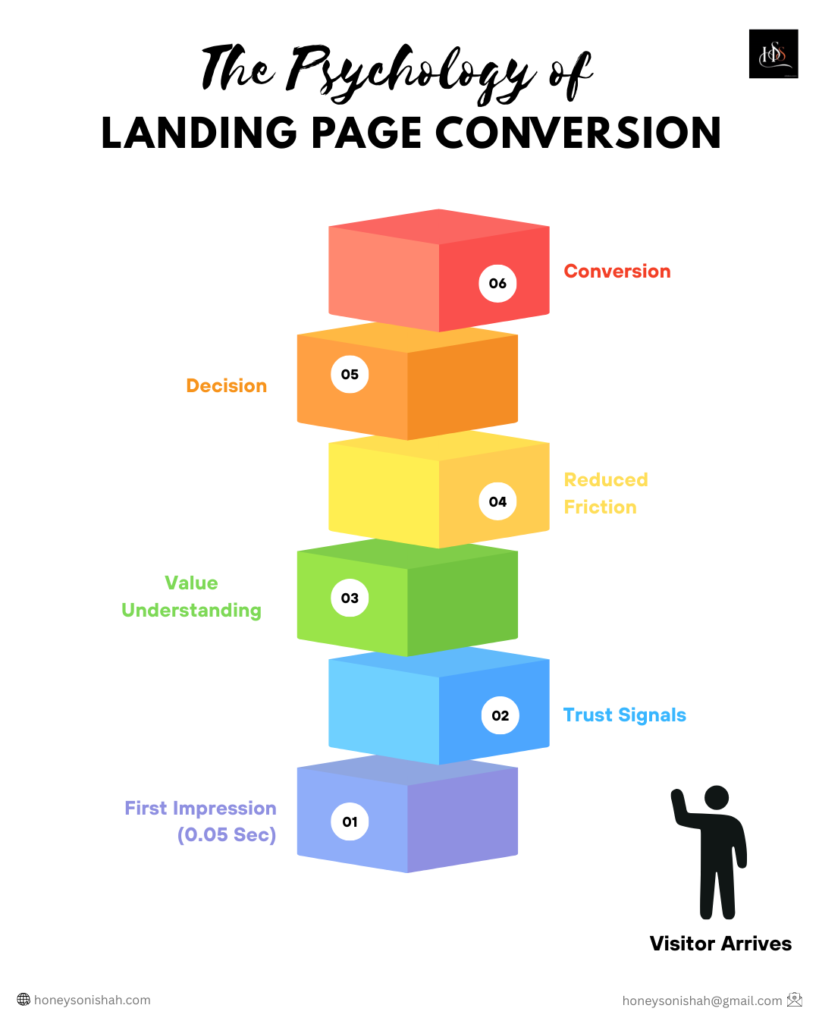
Studies show that users form an opinion about a webpage in just 0.05 seconds, meaning your landing page must communicate value almost instantly.
Another insight: simpler writing converts significantly better than complex language, with easy-to-read content achieving about 11.1% conversion rates compared to 5.3% for complex text.
This demonstrates a critical truth:
| High-converting landing pages are not just well designed; they are psychologically optimized.
Key Psychological Principles Behind High-Converting Landing Pages
1. The First Impression Effect (Primacy Bias)
When visitors land on a page, the first few seconds determine whether they stay or leave. Psychologists call this the Primacy Effect, where people remember and judge information based on what they see first.
This is why the hero section of a landing page is critical. A strong landing page headline should instantly answer three questions:
✔️ What is this?
✔️ Who is it for?
✔️ Why should I care?
Example:
Instead of a vague headline like “Transform Your Business Today”, A better psychological approach is: “Automate Your Business Workflows in Minutes, No Coding Required.”
The second version clearly communicates value and outcome, reducing cognitive friction.
2. Cognitive Load Reduction
Humans naturally avoid complex decisions. If a landing page feels overwhelming, users simply leave.
This concept is known as cognitive load.
High-converting landing pages simplify the decision process by:
✔️ limiting choices
✔️ using clear visual hierarchy
✔️ reducing text clutter
✔️ guiding attention toward the CTA
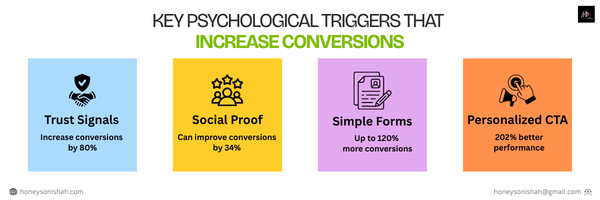
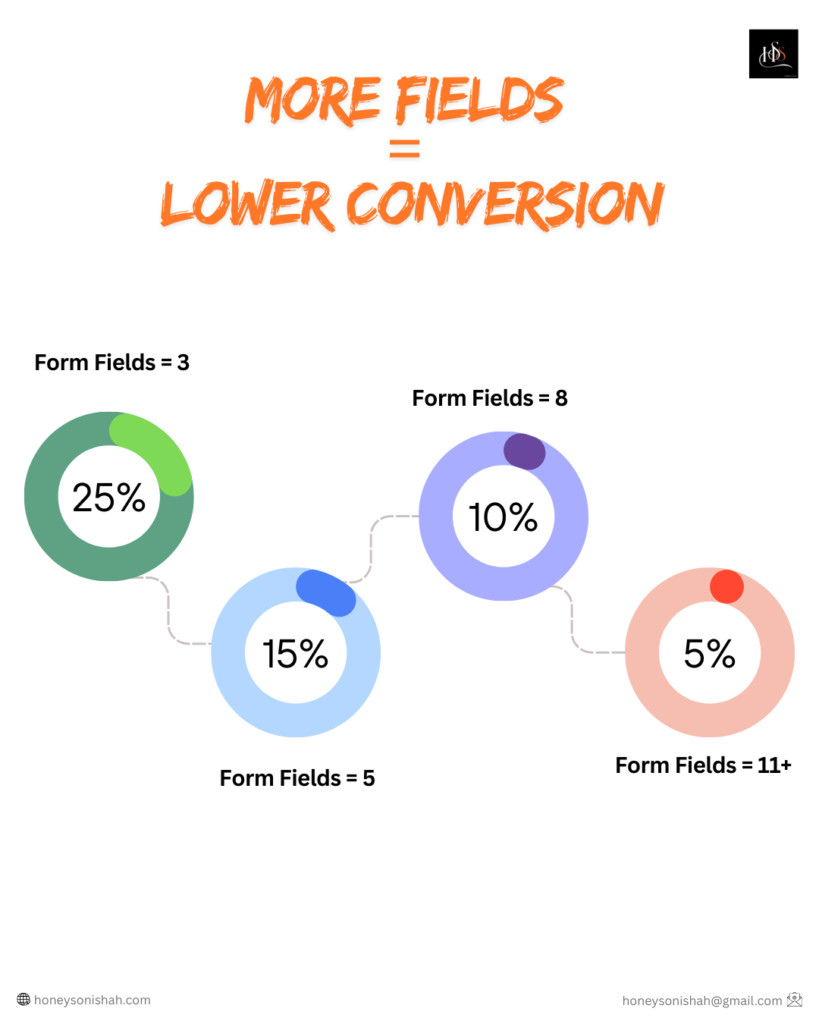
Research shows that reducing form fields significantly increases conversions. For example, reducing form fields from 11 to 4 can increase conversions by up to 120%.
This principle explains why minimal landing pages often outperform complex ones.
3. Social Proof and Trust Signals
Humans are strongly influenced by the behavior of others. This is called social proof, and it is one of the most powerful conversion triggers.
Examples of social proof include:
✔️ Testimonials
✔️ Customer reviews
✔️ Case studies
✔️ Client logos
✔️ User counts
Data suggests that adding social proof can increase landing page conversions by up to 34%.
A landing page with “Trusted by 10,000+ businesses” & “Rated 4.8 stars by customers”, immediately reduces perceived risk. This psychological reassurance encourages users to take action.
4. Scarcity and Loss Aversion
Humans are more motivated to avoid losses than to gain benefits. This is called loss aversion in behavioral psychology. Landing pages leverage this by introducing scarcity elements such as:
✔️ Limited time offers
✔️ Countdown timers
✔️ Limited seats
✔️ Early-bird pricing
For Example:
↪ “Only 20 spots left”
↪ “Offer expires tonight”
These signals create urgency and prevent decision procrastination. However, scarcity must be genuine, fake urgency can damage trust.
5. Visual Hierarchy and Attention Flow
A high-converting landing page does not leave users wondering where to look. Instead, it guides the visitor’s eyes through a structured journey. The psychological path usually follows this flow:
1️⃣ Headline
2️⃣ Sub-headline
3️⃣ Visual/illustration
4️⃣ Benefits
5️⃣ Social proof
6️⃣ Call-to-action
This structure mirrors how the human brain processes information. Eye-tracking studies show users typically scan pages in F-shaped or Z-shaped patterns, meaning strategic placement of key elements is essential.
6. Trust and Risk Reduction
Every conversion decision involves perceived risk. Visitors may ask:
↪ Is this trustworthy?
↪ Will my data be safe?
↪ Is this worth my time?
High-converting landing pages reduce these fears using trust signals, including:
➡️ Security badges
➡️ Privacy assurances
➡️ Guarantees
➡️ Transparent pricing
➡️ Customer testimonials
Research indicates that addressing customer fears can increase conversions by up to 80%. Trust is often the deciding factor between hesitation and conversion.
7. Personalization and Relevance
People respond better when content feels personalized. Personalized landing pages often include:
↪ Industry-specific messaging
↪ Dynamic content based on ad keywords
↪ Personalized CTAs
Studies show personalized CTAs perform about 202% better than generic ones. This works because visitors feel the page is directly relevant to their needs.
Additional CRO Elements That Improve Conversions
Beyond psychology, several practical elements also influence landing page performance:
▣ Mobile optimization
About 86% of high-performing landing pages are mobile-friendly, emphasizing the importance of responsive design.
▣ Video content
Landing pages with videos can improve conversions by up to 86% because videos quickly communicate value.
▣ Page speed
A delay of just one second can reduce conversion rates by around 4.4%.
These factors support the psychological principles discussed earlier.
Conclusion
High-converting landing pages are not created by accident. They are carefully designed using principles from behavioral psychology and conversion rate optimization. The most successful landing pages:
↪ Communicate value instantly
↪ Reduce cognitive friction
↪ Build trust
↪ Leverage social proof
↪ Guide visitors toward a single action
Understanding the psychology behind high-converting landing pages helps businesses transform website traffic into leads and customers.
In a competitive digital environment, the difference between a 2% and a 10% conversion rate can significantly impact marketing ROI and that difference often comes down to psychology.
FAQs